
Dissection, Labor and Science in Colonial India

Throughout history, there has been a tension between medical ethics and scientific advancement. How can we expand medical knowledge while respecting the dignity and justice owed to every human life? Power structures often sharpen this tension, as oppressed groups frequently become the scapegoats or test subjects of medical progress.
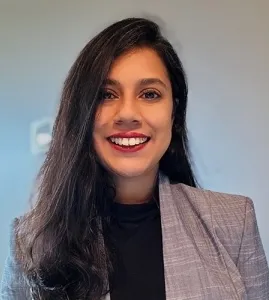
On November 19, join Sohini Chattopadhyay as she examines the case of Annette Benson, a campaigner for women’s medical rights in India and Superintendent of Cama Hospital in Bombay, who dissected the body of Manoobai Chand under the pretense that her body was “unclaimed.” The lecture traces the relationship between Benson and Chand to reveal how value, labor, and scientific authority intersect.
Ahead of the event, we spoke with Sohini Chattopadhyay to learn what drew her to this research and the intellectual frameworks that shape her lecture.
For years before I stumbled upon Manoobai’s story, I was trying to piece together, very unsuccessfully, a history of “unclaimed bodies”: my initial impulse was to recuperate their existence. I would get information through the number of dissections in medical colleges, and tally with the annual averages in burial and cremation records. The numbers in medical college reports were usually a sentence or so in 200-300 page-long annual reports, often in passive voice such as “75 bodies were dissected in 1921-1922.” As a result, Manoobai’s story was exceptional: her name was on the file, her age and the causes of her death were also clearly marked. At a time when I had sifted through some hundred reports to just find single sentences, I knew that Manoobai snuck into the archive under exceptional circumstances. However, once I found these details, I knew that recuperating voices was a futile exercise.
At the same time, I was reading Anjali Arondekar’s For the Record, which framed a crucial question for me. Writing on sexuality and colonial archive, Arondekar notes that the book pursued the question of how “sexuality is made visible in the colonial archive, and of how this process paradoxically discloses the very limits of that visibility” (Arondekar). This work guided me towards situating Manoobai within the question of how her corpse and her life were made visible in the colonial archive. Being trained as a historian of science and thinking through production of knowledge, I also wanted to know how the specifics of her visibility propelled medical knowledge production and assertion of expertise.
In the context of anatomical research in nineteenth-century India, medical archives essentially serve as documents encoding violence, where violence lies in a careful depoliticization and erasure of past lives. I show that the term “unclaimed body” emerged as a neutral descriptor, through the process of denying many people their labor. For instance, I show through census records how “beggars” and “paupers,” two terms used to describe Manoobai, were categorized in Bombay’s census as “unproductive professions.” I contextualize the emergence of the category “unproductive profession” within demographic shifts in Bombay in the first two decades of the twentieth century.
In the case that I present, extraction and violations are the product of a slow transformation in perceptions of urban workers on the one hand, and a general idea that bodies of paupers, prison and hospital inmates, who were unclaimed, should serve scientific research. I contextualize this shift through anti-migrant sentiments in Bombay. Driven by escalating migration from the Deccan region due to famines between the 1870s and 1900s, the police forces doubled between 1890 and 1900 as the city witnessed a rising number of migrant workers, and we also see a surge in negative connotations around them.
Further, Benson was also trained in Britain, where the Anatomy Act of 1832 had solidified the idea that bodies of the poor were amenable to dissection. All this is to say, scientific and colonial institutions operated in a field of discourse that already made violations not only appear legitimate, but also trivial.
Be sure to join us on November 19 at 6pm in-person or online for Claiming Manoobai Chand’s Body: Dissection, Labor and Science in Colonial India! Registration is required. This event is free and open to the public, but in-person guests without an active Columbia University ID must register by 4pm on November 18.
This event is part of the New York History of Science Lecture Series.
Sponsoring Organizations:
- Columbia University in the City of New York
- NYU Gallatin School of Individualized Study
- The Graduate Center, City University of New York
- The New York Academy of Medicine
- The New York Academy of Sciences